Wisconsin Car Accident Lawyer

Car accidents in Wisconsin can leave victims facing serious injuries, lost income, and overwhelming financial stress. Understanding Wisconsin car accident laws, fault rules, deadlines, and compensation options is critical to protecting your legal rights after a crash - that's why you need a Wisconsin car accident lawyer on your side.

Car accidents in Wisconsin can leave victims facing serious injuries, lost income, and overwhelming financial stress. Understanding Wisconsin car accident laws, fault rules, deadlines, and compensation options is critical to protecting your legal rights after a crash – that’s why you need a Wisconsin car accident lawyer on your side.

This guide explains how Wisconsin handles car accident claims, what makes accidents in the state unique, and what injured victims need to know before dealing with insurance companies.


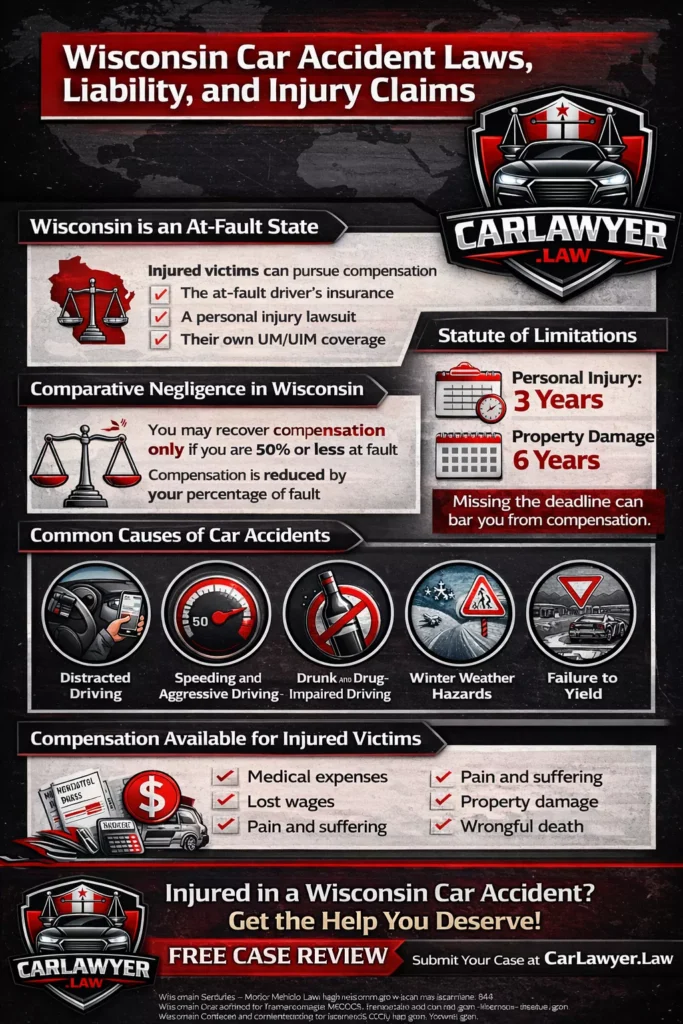
Infographic explaining Wisconsin car accident laws and injury claims, featuring the CarLawyer.Law logo. The graphic highlights Wisconsin’s at-fault insurance system, modified comparative negligence rule, statute of limitations, minimum insurance requirements, common accident causes and injuries, high-risk highways, and available compensation for injured car accident victims.

Wisconsin Is an At-Fault Car Accident State

Wisconsin follows an at-fault (tort-based) system for car accidents. This means the driver who caused the crash is financially responsible for the resulting damages.

In Wisconsin, injured victims can pursue compensation through:

  • The at-fault driver’s liability insurance
  • A personal injury lawsuit
  • Their own uninsured or underinsured motorist coverage

Fault is often determined by:

  • Police accident reports
  • Witness statements
  • Traffic camera or dashcam footage
  • Accident reconstruction analysis

Comparative Negligence in Wisconsin

Wisconsin uses a modified comparative negligence rule known as the 51% bar rule.

  • You may recover compensation only if you are 50% or less at fault
  • Your compensation is reduced by your percentage of fault
  • If you are 51% or more at fault, you cannot recover damages

Example:
If you are awarded $100,000 but found 20% at fault, your recovery is reduced to $80,000.

Insurance companies frequently attempt to inflate a victim’s fault percentage to reduce payouts, making legal representation especially important.


Wisconsin Statute of Limitations for Car Accidents

Wisconsin law strictly limits how long accident victims have to file claims:

  • Personal injury: 3 years from the date of the accident
  • Property damage: 6 years
  • Wrongful death: 3 years from the date of death

Missing the statute of limitations almost always results in losing your right to compensation.


Wisconsin Car Insurance Requirements

Wisconsin requires all drivers to carry minimum auto insurance coverage:

  • $25,000 per person for bodily injury
  • $50,000 per accident for bodily injury
  • $10,000 for property damage
  • Uninsured motorist (UM) coverage is required

Underinsured motorist (UIM) coverage is optional but highly recommended, especially given the rising number of underinsured drivers in Wisconsin.


Uninsured and Underinsured Motorist Claims in Wisconsin

If you are injured by a driver with no insurance or insufficient coverage, you may file a claim under your own policy.

Uninsured Motorist (UM) Coverage

  • Mandatory in Wisconsin
  • Covers injuries caused by uninsured drivers or hit-and-run accidents

Underinsured Motorist (UIM) Coverage

  • Optional but critical
  • Applies when the at-fault driver’s policy limits are insufficient

UM and UIM claims are often contested aggressively by insurers, even though they are your own provider.


High-Risk Roads and Traffic Corridors in Wisconsin

Certain highways and corridors in Wisconsin experience higher accident rates due to traffic congestion, weather, and commercial vehicle volume, including:

  • Interstate 94 (I-94) – Milwaukee to Madison corridor
  • Interstate 90 (I-90) – Major north-south route
  • Interstate 43 (I-43) – Milwaukee to Green Bay
  • Highway 41 – Heavy commuter and commercial traffic
  • Urban Milwaukee roadways

Snow, ice, and reduced visibility significantly increase crash severity during Wisconsin winters.


Common Causes of Car Accidents in Wisconsin

Distracted Driving

Texting, GPS use, and in-car distractions remain leading causes of crashes statewide.

Speeding and Aggressive Driving

Speed-related crashes are especially deadly on interstates and rural highways.

Drunk and Drug-Impaired Driving

Despite enforcement efforts, impaired driving continues to cause severe and fatal collisions.

Winter Weather Conditions

Snow, ice, and black ice create hazardous driving conditions unique to Wisconsin.

Failure to Yield

Intersections and left-turn accidents are common causes of serious injury crashes.


Common Car Accident Injuries in Wisconsin

Car accidents frequently result in life-altering injuries, including:

Even injuries that seem minor initially can worsen over time and require extensive medical care.


Compensation Available in Wisconsin Car Accident Claims

Injured victims may be entitled to recover compensation for:

Insurance companies often undervalue claims and push quick settlements that fail to cover long-term costs.


Why Wisconsin Car Accident Cases Are Complex

Wisconsin car accident claims often involve:

  • Comparative fault disputes
  • Multiple insurance policies
  • UM/UIM coverage conflicts
  • Severe winter-weather liability issues
  • Disputes over long-term medical care

Without legal guidance, victims are often pressured into settlements that do not reflect the true value of their case.


Get Help After a Wisconsin Car Accident

If you or a loved one was injured in a Wisconsin car accident, you do not have to face insurance companies alone. An experienced car accident lawyer can investigate your crash, protect your rights, and fight for full compensation.

Complete our free case evaluation form today to find out how we can help you move forward.


Sources

  1. Wisconsin Statutes – Motor Vehicle Law
    https://docs.legis.wisconsin.gov/statutes/statutes/346
    Official Wisconsin traffic and vehicle regulations.
  2. Wisconsin Department of Transportation (WisDOT)
    https://wisconsindot.gov
    Accident data, road safety, and insurance requirements.
  3. Wisconsin Office of the Commissioner of Insurance
    https://oci.wi.gov
    Authoritative information on auto insurance and UM/UIM coverage.