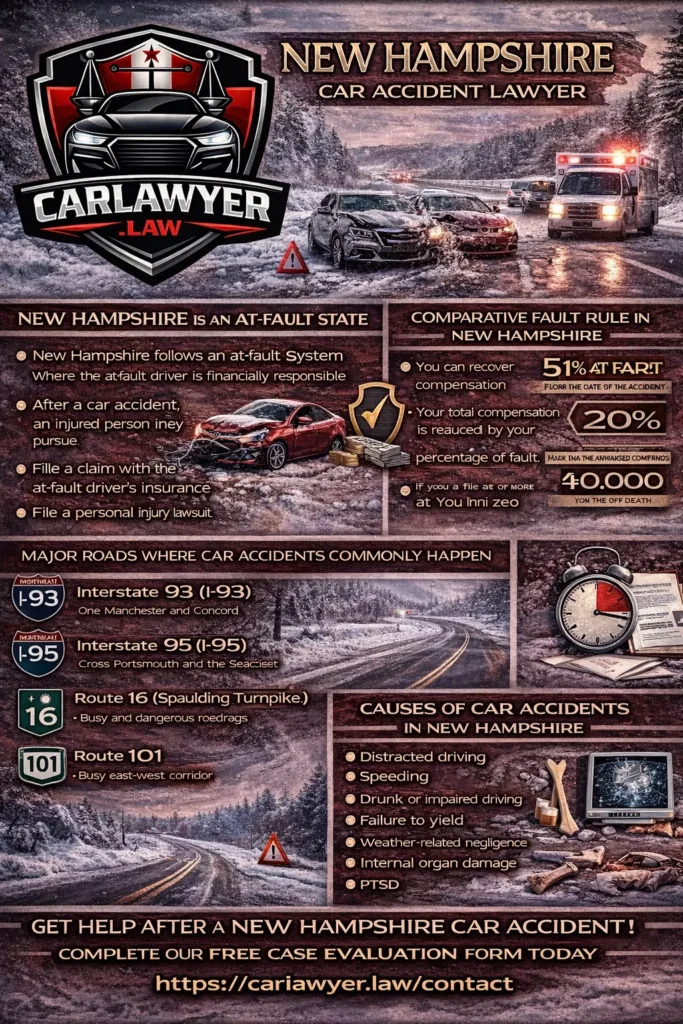
Car accidents in New Hampshire can leave victims facing serious injuries, financial stress, and uncertainty about their legal options. Because New Hampshire has several unique car accident laws, understanding how fault, insurance, and deadlines work is critical to protecting your claim. That’s why you need to hire a New Hampshire car accident lawyer to help you get the compensation that you deserve.
Below is a comprehensive, car-accident-only guide to New Hampshire car accident laws, causes of crashes, injuries, compensation, and what to do next if you were hurt.

New Hampshire follows an at-fault (tort) system for car accidents. This means the driver who caused the crash is financially responsible for the damages.
After a car accident, an injured person may pursue compensation by:
Unlike some states, New Hampshire does not require drivers to carry auto insurance, which can complicate claims when the at-fault driver is uninsured.
New Hampshire uses a modified comparative negligence rule.
Example:
If you are awarded $100,000 but found 20% at fault, you can still recover $80,000. If you are found 51% or more at fault, you recover nothing.
Insurance companies frequently try to shift blame to reduce payouts, making legal representation especially important.

Strict deadlines apply to car accident claims in New Hampshire. Missing these deadlines usually means losing your right to compensation.
Certain exceptions may apply, but courts apply these deadlines strictly. Acting early helps preserve evidence and protects your claim.
New Hampshire is one of the few states that does not require drivers to carry auto insurance. However, drivers who choose not to carry insurance must demonstrate financial responsibility if they cause a crash.
If you are hit by an uninsured driver, recovery may depend on:
Because uninsured drivers are common, UM coverage plays a critical role in many New Hampshire car accident cases.
Car accidents frequently occur on New Hampshire’s busiest roadways, including:
Seasonal tourism, winter weather, and rural road conditions contribute significantly to crash risks across the state.

Most car accidents are preventable and caused by driver negligence. Common causes include:
Identifying the cause of the crash is essential for proving liability and maximizing compensation.
Car accident injuries range from minor to life-altering. Common injuries include:
Some injuries may not appear immediately, which is why prompt medical evaluation is critical after any crash.
Injured victims may be entitled to compensation for both economic and non-economic damages, including:
The value of a claim depends on injury severity, fault allocation, insurance coverage, and long-term impact on the victim’s life.

New Hampshire car accident cases often involve:
Insurance companies are focused on minimizing payouts, not protecting your rights.
If you were injured in a New Hampshire car accident, you do not have to face the insurance companies alone. Legal guidance can help you investigate the crash, prove fault, and pursue the full compensation you deserve.
Take the next step today.
Complete our free case evaluation form to discuss your New Hampshire car accident case with CarLawyer.Law.