Car accidents can happen anywhere in Oregon—from congested Portland roadways to rural highways cutting through the Cascades and high desert. If you or a loved one has been injured in a crash, understanding Oregon car accident laws is essential to protecting your rights and pursuing full compensation – that’s why you need an Oregon car accident lawyer.
Below is a comprehensive, state-specific guide to Oregon car accident claims, liability rules, deadlines, and what injured victims need to know.

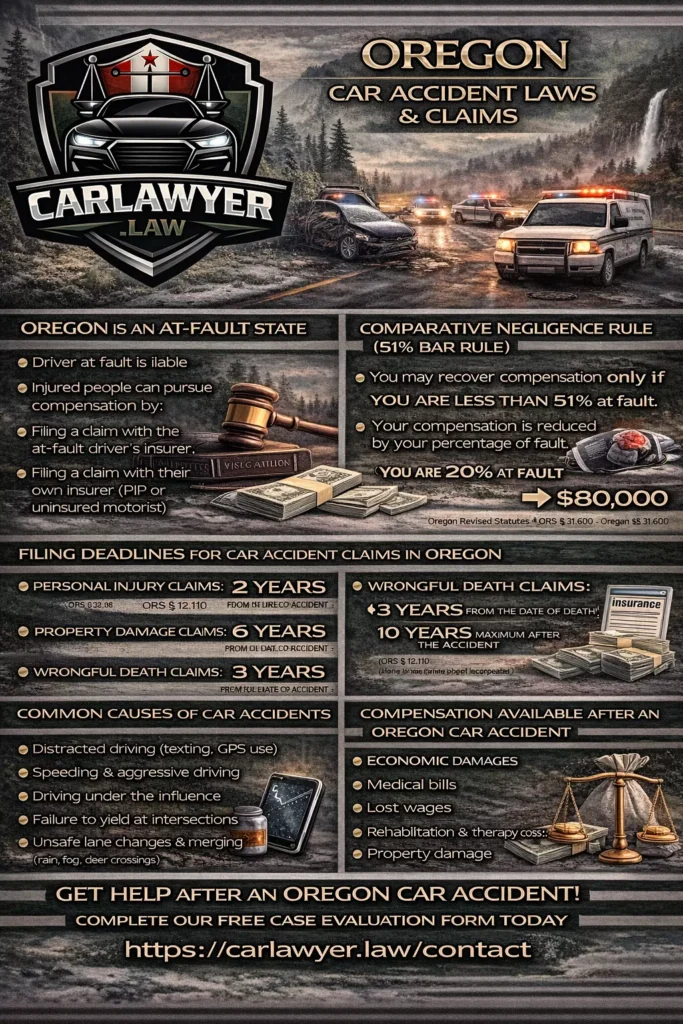
Oregon follows an at-fault (tort-based) system for car accidents. This means the driver who caused the crash is financially responsible for the injuries and damages suffered by others. Injured victims typically pursue compensation through:
Unlike no-fault states, Oregon allows injured victims to pursue pain and suffering damages directly from the at-fault driver.
Oregon uses a modified comparative negligence system with a 51% bar rule.
Example:
If your damages total $100,000 and you are found 20% at fault, you may recover $80,000. If you are 51% or more at fault, you recover nothing.
Insurance companies frequently try to shift blame to reduce payouts, making legal representation especially important in disputed liability cases.

Strict filing deadlines apply to Oregon car accident claims. Missing these deadlines can permanently bar your right to compensation.
Because exceptions and tolling rules may apply, it is critical to speak with a car accident lawyer as soon as possible.
Oregon law requires all drivers to carry minimum liability insurance, including:
While these minimums satisfy legal requirements, they are often inadequate in serious injury cases. Many victims must rely on uninsured or underinsured motorist coverage to fully recover damages.
Certain roadways in Oregon see higher crash volumes due to traffic density, speed, and weather conditions:
Urban congestion, rain, fog, snow, and wildlife crossings all contribute to elevated crash risks across the state.

Many Oregon car accidents result from preventable driver behavior, including:
Identifying the true cause of the accident is key to proving liability and maximizing compensation.
Even seemingly minor crashes can result in serious or long-term injuries, such as:
Medical documentation plays a critical role in establishing the severity and long-term impact of these injuries.
Depending on the circumstances of your case, you may be entitled to compensation for:
Insurance companies often undervalue claims, particularly non-economic damages, making legal advocacy essential.
Insurance adjusters are trained to protect their company’s bottom line—not your recovery. Common tactics include:
Before accepting any settlement, it is critical to understand the full value of your claim and future medical needs.

An experienced car accident lawyer can:
Legal representation often results in significantly higher recoveries than handling a claim alone.
If you were injured in a car accident anywhere in Oregon, you do not have to face the legal process alone. Protect your rights and explore your legal options today.
Complete our free case evaluation form to speak with an experienced car accident attorney and learn how we can help you pursue the compensation you deserve.