Minnesota Car Accident Lawyer

Car accidents in Minnesota are governed by a unique blend of no-fault insurance rules, strict statutory deadlines, and state-specific liability standards that can significantly impact an injured person’s right to recover compensation. Whether your crash occurred in Minneapolis, St. Paul, Duluth, or along one of Minnesota’s major trucking corridors, understanding these laws is essential to protecting your claim - that's why you need a Minnesota truck accident lawyer.

Car accidents in Minnesota are governed by a unique blend of no-fault insurance rules, strict statutory deadlines, and state-specific liability standards that can significantly impact an injured person’s right to recover compensation. Whether your crash occurred in Minneapolis, St. Paul, Duluth, or along one of Minnesota’s major trucking corridors, understanding these laws is essential to protecting your claim – that’s why you need a Minnesota truck accident lawyer.

Below is a comprehensive, state-specific overview of Minnesota car accident law, including statutes of limitations, major highways, and what makes accident claims in Minnesota different from other states.


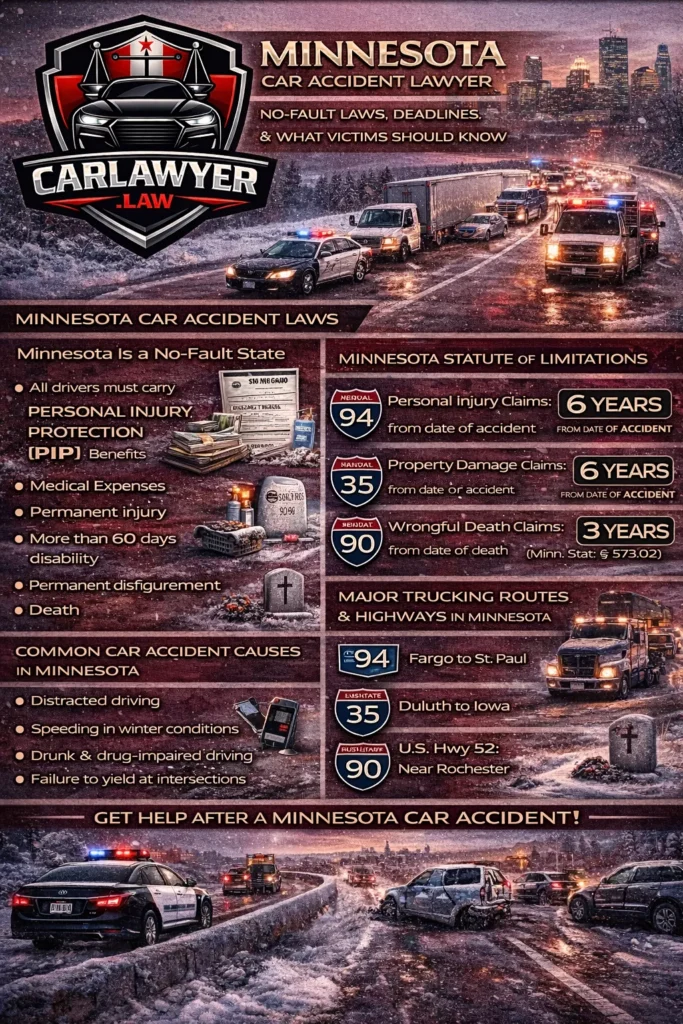
Infographic titled “Minnesota Car Accident Lawyer” by CarLawyer.Law, featuring the CarLawyer.Law logo and a snowy Minnesota highway crash scene. The graphic explains Minnesota’s no-fault car accident laws, Personal Injury Protection (PIP) benefits, statute of limitations deadlines for personal injury, property damage, and wrongful death claims, common causes of car accidents, and major trucking routes including I-94, I-35, and U.S. Highway 52.

Minnesota Car Accident Laws

Minnesota Is a No-Fault Insurance State

Minnesota operates under a no-fault car insurance system, meaning your own insurance typically pays for certain losses regardless of who caused the crash. All drivers are required to carry Personal Injury Protection (PIP) coverage, which provides benefits such as:

  • Medical expenses
  • Lost wages
  • Replacement services
  • Funeral expenses (in fatal accidents)

However, no-fault does not eliminate your right to sue. You may step outside the no-fault system and pursue a liability claim against the at-fault driver if your injuries meet Minnesota’s legal threshold.

When You Can Sue the At-Fault Driver

You may file a car accident lawsuit in Minnesota if any of the following apply:

  • Medical expenses exceed $4,000 (excluding diagnostic tests)
  • You suffer a permanent injury
  • You suffer permanent disfigurement
  • You suffer a disability lasting 60 days or more
  • The accident results in death

Once the threshold is met, you may seek compensation for pain and suffering, future medical care, and other non-economic damages.


Minnesota Statute of Limitations (Verified)

Minnesota provides longer filing deadlines than many states, but missing them can permanently bar your claim.

  • Personal Injury (Car Accidents):
    6 years from the date of the accident
    (Minn. Stat. § 541.05)
  • Property Damage:
    6 years from the date of the accident
  • Wrongful Death:
    3 years from the date of death
    No more than 6 years from the act or omission that caused the death
    (Minn. Stat. § 573.02)

Because certain claims—especially those involving government vehicles or commercial trucking companies—may have shorter notice requirements, it is critical to act quickly.


Major Trucking Corridors & Highways in Minnesota

Minnesota is a major transportation hub for the Upper Midwest, and large commercial trucks are a constant presence on its roads. High-risk trucking corridors include:

  • I-94 – Runs east-west between Fargo, St. Cloud, Minneapolis, and St. Paul
  • I-35 – Major north-south corridor connecting Duluth to Iowa
  • I-90 – Southern Minnesota freight route
  • U.S. Highway 52 – Heavy commercial traffic near Rochester
  • Highway 169 – Common route for construction and industrial trucking

Truck accidents on these highways often involve higher speeds, severe injuries, and complex liability issues, especially when multiple parties are involved.


What Makes Minnesota Car Accidents Unique

Several factors distinguish Minnesota car accident claims from those in other states:

  • No-fault insurance with a lawsuit threshold
  • Longer statute of limitations than many states
  • Harsh winter driving conditions, increasing multi-vehicle crashes
  • Frequent commercial trucking traffic, especially during agricultural and construction seasons
  • Comparative fault rules, which can reduce compensation if you share blame

Minnesota follows a modified comparative negligence rule, meaning you can recover damages only if you are less than 51% at fault.


Common Causes of Car Accidents in Minnesota

Car accidents across Minnesota frequently result from:


Common Injuries in Minnesota Car Accidents

Because of high-speed highways and winter conditions, Minnesota crashes often result in serious injuries, including:

These injuries frequently exceed no-fault thresholds, allowing victims to pursue full compensation from the at-fault party.


Compensation Available After a Minnesota Car Accident

Depending on your case, compensation may include:

Truck accident cases may also involve claims against employers, logistics companies, maintenance contractors, or vehicle manufacturers.


Get Help After a Minnesota Car Accident

Minnesota’s no-fault laws, liability thresholds, and long statutes of limitations can be deceptively complex. Insurance companies often use these rules to delay or minimize payouts.

If you were injured in a Minnesota car accident, the best next step is to speak with an experienced legal team who understands both no-fault insurance and serious injury claims.

Complete our free case evaluation form today to learn your legal options and protect your right to compensation.

3 Authoritative Sources

  1. Minnesota Statutes – Motor Vehicle and Personal Injury Laws
    Official source for Minnesota’s car accident laws, fault rules, and statutes of limitations.
    https://www.revisor.mn.gov/statutes/
  2. Minnesota Department of Public Safety (DPS) – Office of Traffic Safety
    Provides data on car accidents, common causes of crashes, and roadway safety information in Minnesota.
    https://dps.mn.gov/divisions/ots/Pages/default.aspx
  3. Federal Motor Carrier Safety Administration (FMCSA)
    Authoritative source for trucking regulations, commercial vehicle safety rules, and interstate trucking corridors affecting Minnesota.
    https://www.fmcsa.dot.gov/