Pennsylvania Car Accident Lawyer

Car accidents in Pennsylvania can lead to serious injuries, financial strain, and long-term consequences for victims and their families. Understanding Pennsylvania’s unique car accident laws, insurance rules, and filing deadlines is critical if you want to protect your rights and pursue full compensation - that's why you need a Pennsylvania car accident lawyer.

Car accidents in Pennsylvania can lead to serious injuries, financial strain, and long-term consequences for victims and their families. Understanding Pennsylvania’s unique car accident laws, insurance rules, and filing deadlines is critical if you want to protect your rights and pursue full compensation – that’s why you need a Pennsylvania car accident lawyer.

Below is a comprehensive, state-specific guide to Pennsylvania car accident claims, including fault rules, statutes of limitations, major roadways, common causes of crashes, injuries, and the compensation available to accident victims.


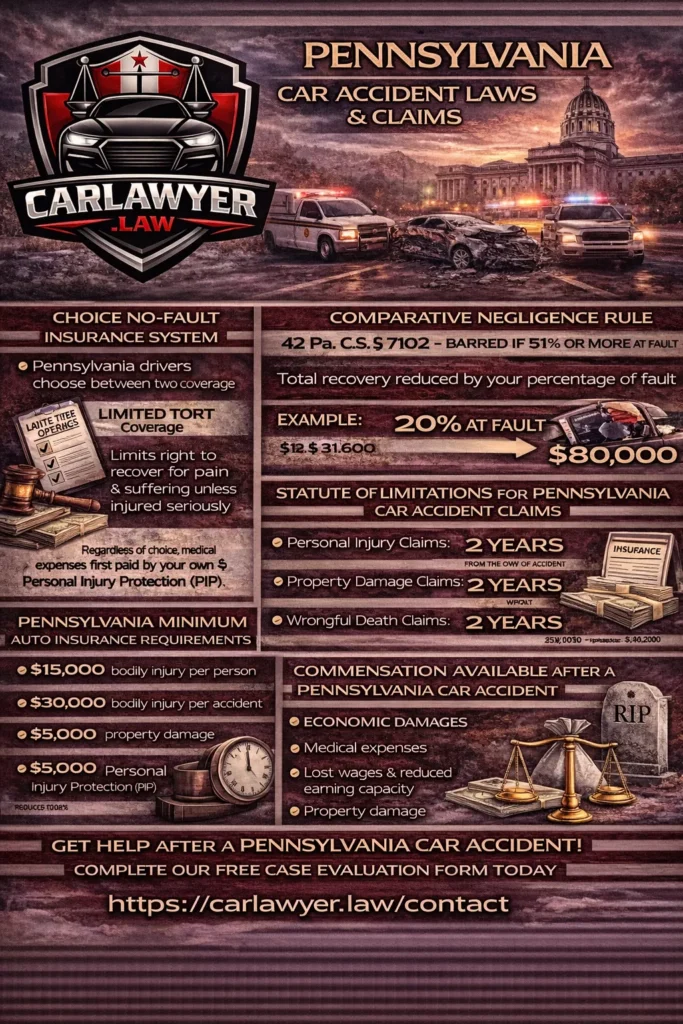
Infographic for CarLawyer.Law explaining Pennsylvania car accident laws, featuring the CarLawyer.Law shield logo, a Pennsylvania cityscape, and a crash scene. The infographic outlines Pennsylvania’s choice no-fault insurance system, limited tort vs. full tort coverage, comparative negligence rules, statute of limitations for car accident claims, minimum auto insurance requirements, and types of compensation available after a car accident, with a call to action to complete a free case evaluation form.

Is Pennsylvania a Fault or No-Fault State for Car Accidents?

Pennsylvania operates under a choice no-fault insurance system, which means drivers choose their level of coverage when purchasing auto insurance:

  • Limited Tort Coverage:
    This option limits your right to recover non-economic damages (such as pain and suffering) unless your injuries meet the legal definition of a “serious injury.”
  • Full Tort Coverage:
    This option preserves your unrestricted right to pursue compensation for pain and suffering, emotional distress, and other non-economic damages after a car accident.

Regardless of which option you choose, medical expenses are initially covered by your own Personal Injury Protection (PIP) benefits.


Comparative Negligence in Pennsylvania

Pennsylvania follows a modified comparative negligence rule under 42 Pa. C.S. § 7102. Key points include:

  • You may recover compensation as long as you are not more than 50% at fault for the accident.
  • Your total compensation is reduced by your percentage of fault.
  • If you are found 51% or more at fault, you are barred from recovering damages.

This rule makes fault determinations a critical part of Pennsylvania car accident claims.


Statute of Limitations for Pennsylvania Car Accidents

Understanding the filing deadlines is essential. Missing the statute of limitations can permanently bar your claim.

  • Personal Injury Claims: 2 years from the date of the accident
  • Property Damage Claims: 2 years from the date of the accident
  • Wrongful Death Claims: 2 years from the date of death

These deadlines are strictly enforced under Pennsylvania law, with limited exceptions.


Pennsylvania Minimum Auto Insurance Requirements

Pennsylvania drivers must carry the following minimum insurance coverage:

  • $15,000 for bodily injury per person
  • $30,000 for bodily injury per accident
  • $5,000 for property damage
  • $5,000 in Personal Injury Protection (PIP)

While these are the legal minimums, serious accidents often result in damages that far exceed available coverage.


Major Pennsylvania Roadways & High-Risk Corridors

Pennsylvania’s dense traffic and extensive highway system contribute to frequent car accidents, especially along major corridors such as:

  • Interstate 76 (Pennsylvania Turnpike)
  • Interstate 95 (Philadelphia region)
  • Interstate 80 (cross-state corridor)
  • Interstate 81 (central and northeastern PA)
  • Interstate 476 (Northeast Extension & Blue Route)
  • U.S. Route 30 (Lincoln Highway)

Urban congestion, construction zones, and winter weather conditions increase accident risks throughout the state.


Common Causes of Car Accidents in Pennsylvania

Distracted Driving

Texting, phone use, GPS navigation, and in-car distractions are among the leading causes of crashes statewide.

Speeding & Aggressive Driving

Excessive speed reduces reaction time and increases the severity of injuries in collisions.

Drunk or Drug-Impaired Driving

Alcohol and drug impairment remain major contributors to fatal and serious injury crashes in Pennsylvania.

Weather-Related Accidents

Snow, ice, fog, and heavy rain frequently contribute to loss-of-control accidents, especially during winter months.

Failure to Yield & Intersection Accidents

Improper turns, red-light violations, and failure to yield commonly cause T-bone and multi-vehicle crashes.


Common Car Accident Injuries

Pennsylvania car accidents can result in a wide range of injuries, from minor to catastrophic:

Many injuries require long-term medical treatment and rehabilitation, significantly impacting victims’ quality of life.


Compensation Available in Pennsylvania Car Accident Claims

Depending on your coverage selection and the facts of your case, you may be entitled to compensation for:

Economic Damages

Non-Economic Damages

(Primarily available under full tort or serious injury exceptions)

  • Pain and suffering
  • Emotional distress
  • Loss of enjoyment of life
  • Permanent disability or disfigurement

Wrongful Death Damages

  • Funeral and burial costs
  • Loss of financial support
  • Loss of companionship and guidance

Why Pennsylvania Car Accident Claims Are Complex

Pennsylvania’s choice no-fault system, combined with comparative negligence rules and insurance coverage limitations, makes car accident cases particularly complex. Insurance companies often dispute:

  • Whether injuries qualify as “serious” under limited tort
  • Fault percentages
  • The necessity and value of medical treatment
  • Long-term damages and future care needs

Having a clear understanding of Pennsylvania law is essential when pursuing a claim.


What to Do After a Car Accident in Pennsylvania

  1. Call 911 and seek medical attention immediately
  2. Report the accident to law enforcement
  3. Document the scene with photos and witness information
  4. Notify your insurance company
  5. Avoid giving recorded statements without legal guidance
  6. Preserve medical records and accident documentation

Get Help With Your Pennsylvania Car Accident Claim

If you or a loved one has been injured in a Pennsylvania car accident, understanding your rights under state law can make a significant difference in your recovery. Do not let insurance companies minimize your injuries or deny the compensation you deserve.

Complete our free case evaluation form to discuss your Pennsylvania car accident case and learn your legal options.


Sources

  1. Pennsylvania General Assembly – Motor Vehicle Financial Responsibility Law
    https://www.legis.state.pa.us
  2. Pennsylvania Department of Transportation (PennDOT) – Crash Statistics
    https://www.penndot.pa.gov
  3. 42 Pa. C.S. § 7102 – Comparative Negligence
    https://www.legis.state.pa.us