Vermont Car Accident Lawyer

Car accidents in Vermont can have life-altering consequences, especially given the state’s rural roads, harsh winter weather, and mix of local traffic with seasonal tourism. If you were injured in a car accident in Vermont, understanding the state’s car accident laws, insurance requirements, and your legal options is critical to protecting your rights and pursuing full compensation - that's why you need a Vermont car accident lawyer.

Car accidents in Vermont can have life-altering consequences, especially given the state’s rural roads, harsh winter weather, and mix of local traffic with seasonal tourism. If you were injured in a car accident in Vermont, understanding the state’s car accident laws, insurance requirements, and your legal options is critical to protecting your rights and pursuing full compensation – that’s why you need a Vermont car accident lawyer.

Below is a comprehensive guide to Vermont car accident laws, liability rules, common causes of crashes, typical injuries, available compensation, and what steps accident victims should take to protect their claims.


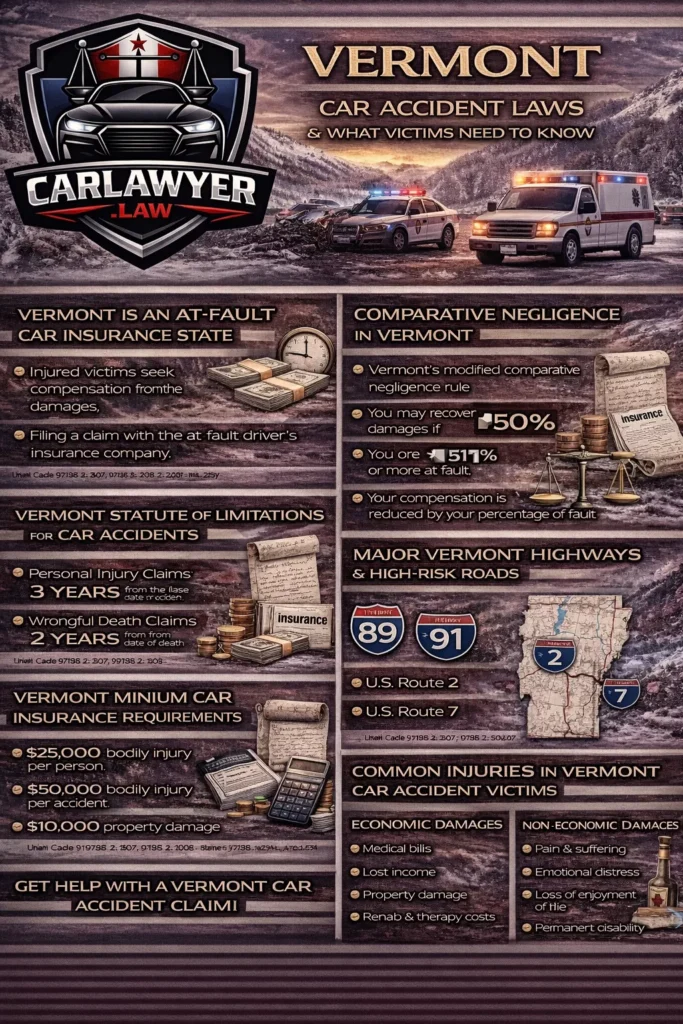
“Infographic explaining Vermont car accident laws by CarLawyer.Law, featuring the CarLawyer.Law logo, a winter Vermont crash scene, and sections on at-fault insurance rules, comparative negligence, statute of limitations, minimum insurance requirements, major highways, common car accident injuries, and available compensation for victims.”

Vermont Is an At-Fault Car Accident State

Vermont follows an at-fault (tort-based) car insurance system. This means the driver who caused the accident is financially responsible for the damages that result.

After a Vermont car accident, an injured victim may pursue compensation by:

  • Filing a claim with the at-fault driver’s insurance company
  • Filing a claim with their own insurer (such as underinsured motorist coverage)
  • Filing a personal injury lawsuit against the at-fault driver

Because fault plays such a central role, insurance companies often dispute liability. Having strong evidence and legal representation can make a major difference in the outcome of your case.


Comparative Negligence in Vermont

Vermont uses a modified comparative negligence rule, sometimes referred to as the “51% rule.”

Under this system:

  • You may recover compensation if you are 50% or less at fault for the accident
  • If you are 51% or more at fault, you are barred from recovering damages
  • Your compensation is reduced by your percentage of fault

Example:
If you are awarded $100,000 in damages but found to be 20% at fault, your recovery would be reduced to $80,000.

Insurance adjusters often try to assign unnecessary blame to accident victims to reduce payouts, making legal guidance especially important.


Vermont Statute of Limitations for Car Accidents

Vermont law places strict deadlines on how long you have to file a lawsuit after a car accident.

  • Personal injury claims: 3 years from the date of the accident
  • Wrongful death claims: 2 years from the date of death
  • Property damage claims: 3 years from the date of loss

Failing to file within the applicable statute of limitations can permanently bar your claim, regardless of how strong the evidence may be.


Vermont Minimum Car Insurance Requirements

All Vermont drivers are required to carry minimum liability insurance coverage, which includes:

  • $25,000 for bodily injury per person
  • $50,000 for bodily injury per accident
  • $10,000 for property damage

While these limits meet legal requirements, they are often insufficient to cover serious injuries. Vermont also requires uninsured and underinsured motorist (UM/UIM) coverage, which can be crucial when the at-fault driver lacks adequate insurance.


Major Vermont Highways & High-Risk Roads

Although Vermont is a largely rural state, several highways and roadways see a higher volume of car accidents:

  • Interstate 89 (I-89): Connects Burlington, Montpelier, and White River Junction
  • Interstate 91 (I-91): Runs north-south along the eastern part of the state
  • U.S. Route 2: A major east-west corridor with heavy local traffic
  • U.S. Route 7: One of Vermont’s busiest roads, especially through western towns

Winter conditions, wildlife crossings, and limited lighting on rural roads increase accident risks across the state.


Common Causes of Car Accidents in Vermont

Car accidents in Vermont occur for many of the same reasons seen nationwide, but the state’s unique conditions add additional hazards.

Distracted Driving

Texting, phone use, GPS adjustments, and in-car distractions remain leading causes of crashes. Vermont law restricts handheld device use, yet distracted driving accidents continue to rise.

Speeding

Excessive speed reduces reaction time and increases crash severity, particularly on winding rural roads and during winter conditions.

Winter Weather & Road Conditions

Snow, ice, black ice, and reduced visibility contribute significantly to Vermont car accidents, especially during long winter months.

Impaired Driving

Alcohol and drug-impaired driving continues to cause serious and fatal crashes across the state.

Failure to Yield

Intersections, rural crossings, and left-turn scenarios frequently lead to collisions when drivers fail to yield the right of way.


Common Injuries in Vermont Car Accidents

Car accident injuries can range from mild to catastrophic. Some of the most common injuries include:

Even injuries that appear minor at first can worsen over time, underscoring the importance of prompt medical evaluation.


Compensation Available to Vermont Car Accident Victims

If you were injured due to another driver’s negligence, you may be entitled to compensation for both economic and non-economic damages.

Economic Damages

Non-Economic Damages

  • Pain and suffering
  • Emotional distress
  • Loss of enjoyment of life
  • Permanent disability or disfigurement

Wrongful Death Damages

In fatal accident cases, surviving family members may pursue compensation for:

  • Funeral and burial costs
  • Loss of financial support
  • Loss of companionship and guidance

What to Do After a Car Accident in Vermont

Taking the right steps after a car accident can significantly impact your claim:

  1. Call 911 and report the accident
  2. Seek immediate medical attention
  3. Document the scene with photos and videos
  4. Collect contact and insurance information
  5. Avoid giving recorded statements to insurers without legal advice
  6. Consult a car accident lawyer as soon as possible

Insurance companies often act quickly to protect their bottom line—having legal representation helps level the playing field.


Why Legal Representation Matters in Vermont Car Accident Claims

Vermont car accident claims can involve complex liability issues, comparative fault disputes, and aggressive insurance tactics. An experienced car accident lawyer can:

  • Investigate the crash and gather evidence
  • Prove fault and counter blame-shifting strategies
  • Calculate the full value of your damages
  • Negotiate with insurance companies
  • Take your case to court if necessary

Speak With a Vermont Car Accident Lawyer Today

If you or a loved one has been injured in a Vermont car accident, you do not have to face the legal process alone. An experienced car accident attorney can help protect your rights and pursue the compensation you deserve.

Complete our free case evaluation form today to discuss your Vermont car accident case and learn your legal options.


Sources

  1. Vermont Statutes Online – Motor Vehicles & Negligence Laws
    https://legislature.vermont.gov/statutes/
  2. Vermont Department of Motor Vehicles – Insurance Requirements
    https://dmv.vermont.gov/registrations/insurance
  3. National Highway Traffic Safety Administration (NHTSA) – Vermont Crash Data
    https://www.nhtsa.gov/road-safety/vermont