Virginia Car Accident Lawyer

Car accidents happen frequently on Virginia’s roadways, from congested urban highways in Northern Virginia and Richmond to rural byways through the Shenandoah Valley. When a crash causes injury or property damage, understanding how Virginia’s laws work can make the difference between a maximum recovery and a claim that falls short - you need a Virginia car accident lawyer to help!

Car accidents happen frequently on Virginia’s roadways, from congested urban highways in Northern Virginia and Richmond to rural byways through the Shenandoah Valley. When a crash causes injury or property damage, understanding how Virginia’s laws work can make the difference between a maximum recovery and a claim that falls short – you need a Virginia car accident lawyer to help!

This comprehensive guide explains Virginia car accident laws, including fault rules, insurance requirements, deadlines, common causes of crashes, typical injuries, the compensation available to victims, and what steps to take after a collision.


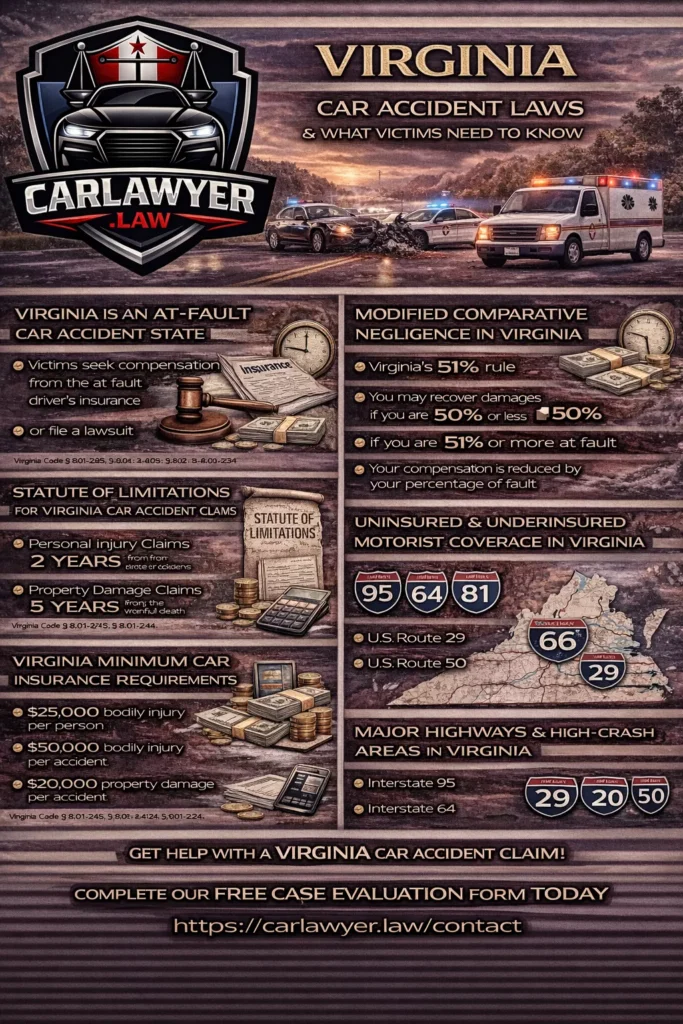
Infographic created by CarLawyer.Law featuring the firm’s logo and a visual summary of car accident laws, common causes of crashes, typical injuries, compensation options, and key legal deadlines, designed to help accident victims understand their rights and next steps after a car accident.

Virginia’s At-Fault Car Accident System

Virginia follows a traditional at-fault (tort) system for car accidents. This means the driver who caused the accident is legally responsible for compensating accident victims for medical bills, lost income, pain and suffering, and other damages.

Under this fault-based system:

  • Injured persons file a claim with the at-fault driver’s insurance company
  • If insurance payments are insufficient, victims can file a personal injury lawsuit
  • Liability must be established before compensation is awarded

Virginia does not operate under a “no-fault” insurance system, so victims are not restricted to their own insurance coverage regardless of fault.


Modified Comparative Negligence in Virginia

Virginia applies a modified comparative negligence rule with a 51% bar.

Under this rule:

  • You may recover compensation only if you are 50% or less at fault
  • If you are found 51% or more at fault, you are barred from recovery
  • Your compensation is reduced by your percentage of fault

For example:
If a jury awards you $100,000 but finds you 30% at fault, your recovery would be reduced to $70,000.

Comparative negligence often becomes a central dispute in accident cases, especially when fault is unclear or multiple drivers are involved.


Statute of Limitations for Virginia Car Accident Claims

Virginia imposes strict deadlines for filing car accident claims in court. These deadlines are called the statute of limitations, and missing them can permanently eliminate your right to compensation.

Personal Injury Claims

  • 2 years from the date of the accident
    (Virginia Code § 8.01-243)

Property Damage Claims

  • 5 years from the date of the accident
    (Virginia Code § 8.01-243)

Wrongful Death Claims

  • 2 years from the date of death
    (Virginia Code § 8.01-244)

Although two years may seem like a long time, evidence such as witness testimony and accident scene data can disappear quickly, making early action essential.


Virginia Minimum Auto Insurance Requirements

All Virginia drivers must carry a minimum amount of liability insurance. The required limits are:

  • $25,000 for bodily injury liability per person
  • $50,000 for bodily injury liability per accident
  • $20,000 for property damage liability per accident

While these minimums satisfy legal requirements, they often fall short in serious crashes. Add-ons such as uninsured/underinsured motorist coverage (UM/UIM) and medical payments coverage (MedPay) can provide additional financial protection.


Uninsured & Underinsured Motorist Coverage in Virginia

Virginia law requires insurers to offer UM/UIM coverage but allows drivers to reject it in writing. Many drivers decline this coverage, which can significantly limit recovery if the at-fault driver lacks insurance or carries only minimum limits.

UM/UIM coverage can help cover:

  • Medical bills
  • Lost wages
  • Pain and suffering
  • Future care costs

If you were hit by an uninsured or underinsured driver, having UM/UIM coverage may be the key to a full recovery.


Major Highways & High-Crash Areas in Virginia

Certain roadways in Virginia are associated with frequent car accidents due to heavy traffic, high speeds, and complex interchanges:

  • Interstate 95 (I-95) — Major north–south route from Northern Virginia through Richmond and Petersburg
  • Interstate 64 (I-64) — Crosses the state from Hampton Roads to Charlottesville and beyond
  • Interstate 81 (I-81) — Heavily traveled rural interstate with speed variations and truck traffic
  • Interstate 66 (I-66) — Congested commuter route into and out of the Washington, D.C. area
  • U.S. Route 29 & U.S. Route 50 — Key corridors in urban and suburban regions

Rush-hour congestion, merging lanes, and frequent construction contribute to the risk of serious collisions.


Common Causes of Car Accidents in Virginia

Understanding why accidents happen can help strengthen a claim. Some of the most common causes in Virginia include:

Distracted Driving

Texting, mobile phone use, navigation systems, and other distractions take drivers’ eyes off the road and hands off the wheel.

Speeding

Driving too fast for conditions is a leading cause of serious and fatal accidents.

Impaired Driving

Alcohol and drug impairment remain major contributors to severe collisions, especially on weekends and holidays.

Failure to Yield

Intersection accidents often occur when drivers fail to yield the right of way.

Tailgating & Aggressive Driving

Following too closely and unsafe lane changes are frequent factors in rear-end and sideswipe crashes.


Common Injuries in Virginia Car Accidents

Car accident injuries can range from mild to catastrophic. Some of the most common injuries include:

Prompt medical evaluation is crucial. Pain or symptoms that seem minor initially may worsen over time.


Compensation Available in Virginia Car Accident Claims

In a successful Virginia car accident claim, a victim may recover both economic and non-economic damages.

Economic Damages

These are tangible financial losses:

Non-Economic Damages

These damages compensate for non-financial losses:

  • Pain and suffering
  • Emotional distress
  • Loss of enjoyment of life
  • Permanent disability or disfigurement

Wrongful Death Damages

In fatal crash cases, family members may recover:

  • Funeral and burial expenses
  • Loss of financial support
  • Loss of companionship and guidance

Virginia does not cap economic damages in standard personal injury car accident cases. However, specific caps may apply in certain medical malpractice-related claims.


Dealing With Insurance Companies in Virginia

Insurance adjusters often begin working immediately after a crash and may try to:

  • Offer lowball settlements
  • Downplay the severity of injuries
  • Shift blame to reduce the insurer’s liability
  • Delay payments

You are not required to give recorded statements to insurance companies without consulting a lawyer. Doing so could harm your claim.


Why Hiring a Virginia Car Accident Lawyer Matters

A skilled car accident attorney can:

  • Investigate the accident and reconstruct the crash
  • Collect police reports, medical records, and expert testimony
  • Evaluate current and future medical needs
  • Handle all communication with insurance companies
  • Negotiate for the maximum possible settlement
  • Represent you in court if a fair settlement isn’t offered

Insurance adjusters have teams and tactics designed to protect the insurer’s bottom line. Having experienced legal representation levels the playing field.


What to Do After a Car Accident in Virginia

Taking the right actions immediately after a crash can strengthen your claim:

1. Call 911

Report the accident and request medical assistance, even if injuries seem minor.

2. Get Medical Treatment

Immediate evaluation establishes a medical record that supports your claim.

3. Document the Scene

Take photos of vehicle damage, road conditions, traffic signals, and visible injuries.

4. Collect Information

Obtain contact and insurance details from all drivers and passengers.

5. Get Witness Information

Witnesses can provide statements to support your version of events.

6. Avoid Recorded Statements

Do not give recorded statements to adjusters without legal counsel.

7. Keep Records

Save medical bills, repair receipts, lost wage documentation, and treatment plans.

8. Contact a Virginia Car Accident Attorney

An attorney can explain your rights and help you pursue full compensation.


Speak With a Virginia Car Accident Lawyer Today

If you were injured in a car accident in Virginia, you don’t have to navigate the legal process alone. A qualified car accident lawyer can protect your rights, negotiate with insurers, and fight for the compensation you deserve.

Complete our free case evaluation form to get started.


Sources

  1. Virginia Code § 8.01-243 – Statute of Limitations
    https://law.lis.virginia.gov/vacode/title8.01/chapter3/section8.01-243/
  2. Virginia Department of Motor Vehicles – Auto Insurance Requirements
    https://www.dmv.virginia.gov/vehicles/#insurance.asp
  3. National Highway Traffic Safety Administration – Virginia Crash Data
    https://www.nhtsa.gov/road-safety/state/virginia