Washington Car Accident Lawyer

Washington State has some of the busiest trucking corridors in the Pacific Northwest, making car and truck accidents an unfortunate reality for drivers, passengers, and pedestrians alike. If you or a loved one has been injured in a crash, understanding Washington’s accident laws, liability rules, and compensation options is critical to protecting your rights.

Washington State has some of the busiest corridors in the Pacific Northwest, making car accidents an unfortunate reality for drivers, passengers, and pedestrians alike. If you or a loved one has been injured in a car accident, understanding Washington’s accident laws, liability rules, and compensation options is critical to protecting your rights – that’s why you need a Washington car accident lawyer.

Below is a comprehensive, Washington-specific guide covering car accident laws, major highways, common causes, injuries, compensation, and what makes car accidents in Washington uniquely complex.


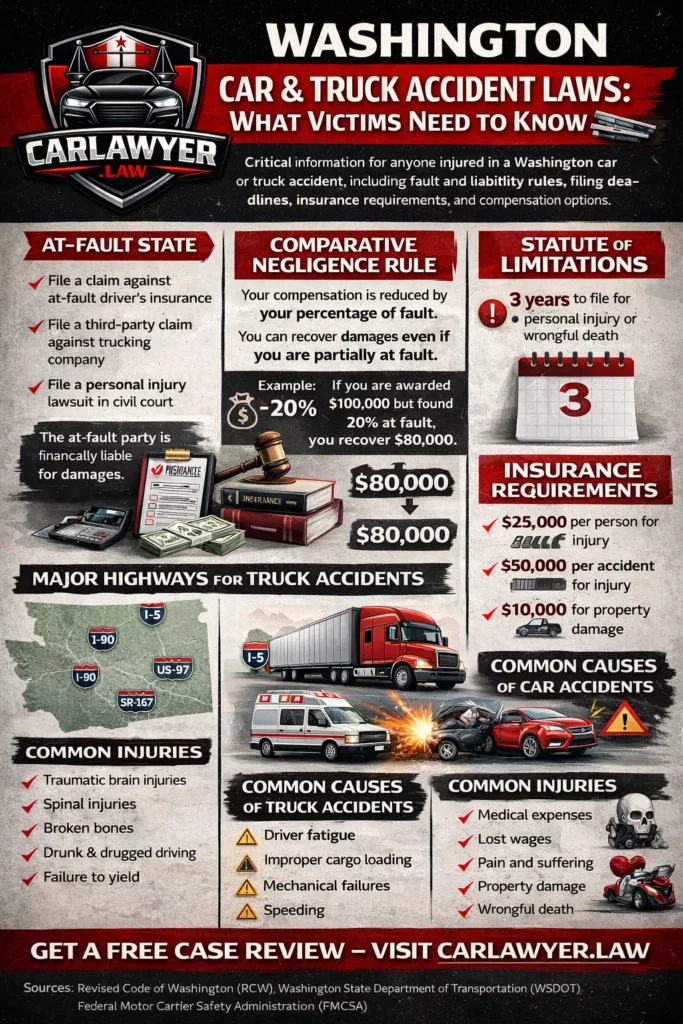
Infographic summarizing Washington car and truck accident laws, featuring the CarLawyer.Law logo. The graphic highlights Washington’s at-fault system, pure comparative negligence rule, three-year statute of limitations, minimum insurance requirements, uninsured and underinsured motorist coverage, major trucking corridors like I-5 and I-90, common accident causes, typical injuries, and compensation available to accident victims.

Washington Is an At-Fault State for Car Accidents

Washington follows an at-fault insurance system, meaning the party responsible for causing the accident is financially liable for damages. Injury victims can pursue compensation by:

  • Filing a claim with the at-fault driver’s insurance company
  • Filing a third-party claim against a trucking company or employer
  • Filing a personal injury lawsuit in civil court

Unlike no-fault states, Washington does not limit your right to sue the at-fault driver for medical expenses, lost wages, or pain and suffering.


Washington’s Comparative Negligence Rule

Washington applies a pure comparative negligence standard under RCW 4.22.005.

This means:

  • You can recover compensation even if you were partially at fault
  • Your total compensation is reduced by your percentage of fault

Example:
If you are awarded $100,000 but found 20% at fault, you can still recover $80,000.

This rule is especially important in multi-vehicle crashes and truck accidents, where insurers often attempt to shift blame onto injured victims.


Statute of Limitations for Washington Accident Claims

Under RCW 4.16.080, Washington generally allows:

  • 3 years from the date of the accident to file a personal injury lawsuit
  • 3 years for wrongful death claims

Missing this deadline almost always results in losing your right to compensation, regardless of how strong your case may be.


Washington Minimum Insurance Requirements

Washington drivers are required to carry the following minimum liability coverage:

  • $25,000 for bodily injury per person
  • $50,000 for bodily injury per accident
  • $10,000 for property damage

Commercial trucks typically carry significantly higher policy limits, often ranging from $750,000 to several million dollars depending on cargo and federal regulations.


Uninsured and Underinsured Motorist Claims in Washington

Washington has a high number of uninsured and underinsured drivers. If the at-fault driver lacks sufficient coverage, you may be able to file a claim under your own:

  • Uninsured Motorist (UM) coverage
  • Underinsured Motorist (UIM) coverage

These claims can become legally complex, as your own insurer may dispute fault or damages.


Major Corridors and Highways in Washington

Accidents frequently occur along Washington’s major freight routes, including:

  • Interstate 5 (I-5) – Runs north–south through Seattle, Tacoma, and Vancouver
  • Interstate 90 (I-90) – A major east–west route connecting Seattle to Spokane
  • Interstate 405 (I-405) – Heavy commercial traffic through the Puget Sound region
  • U.S. Highway 97 – A critical freight route through Central Washington
  • State Route 167 – High truck traffic in the Kent Valley

Congestion, port traffic, weather conditions, and steep mountain passes all increase accident risk


Common Causes of Car Accidents in Washington

Car accidents across Washington are commonly caused by:

Urban congestion and rural highways both present unique dangers for Washington drivers.


Common Injuries in Washington Car Accidents

Accident victims frequently suffer serious and life-altering injuries, including:

Accidents with trucks, in particular, often result in catastrophic or fatal injuries due to the size and weight of commercial vehicles.


Compensation Available to Washington Accident Victims

Depending on your case, you may be entitled to compensation for:

The value of a claim depends on liability, injury severity, insurance coverage, and long-term impact on your life.


Why Legal Representation Matters in Washington Accident Cases

Insurance companies and trucking corporations aggressively defend claims. Without legal guidance, victims risk accepting low settlements that fail to cover long-term needs.

An experienced accident lawyer can:

  • Investigate fault and preserve evidence
  • Handle insurance negotiations
  • Identify all liable parties
  • Maximize compensation under Washington law

Take the Next Step After a Washington Car Accident

If you or a loved one has been injured in a Washington car accident, do not wait to protect your rights. Time-sensitive evidence and strict deadlines can make or break your case.

Complete our free case evaluation form today to discuss your legal options and take the first step toward the compensation you deserve.


Sources

  1. Revised Code of Washington – Comparative Fault & Statute of Limitations
    https://apps.leg.wa.gov/rcw/
  2. Washington State Department of Transportation (WSDOT) – Traffic & Freight Data
    https://wsdot.wa.gov
  3. Federal Motor Carrier Safety Administration (FMCSA) – Trucking Regulations
    https://www.fmcsa.dot.gov