Utah Car Accident Lawyer

Car accidents are an unfortunate reality on Utah’s roads. Whether on Interstates 15 and 80, through downtown Salt Lake City, or on scenic state highways near rural and mountainous regions, crashes can lead to serious injuries, emotional trauma, and financial hardship. If you’ve been injured in a car accident in Utah, understanding how the law works is essential to protecting your rights and pursuing full compensation - that's why you need a Utah car accident lawyer.

Car accidents are an unfortunate reality on Utah’s roads. Whether on Interstates 15 and 80, through downtown Salt Lake City, or on scenic state highways near rural and mountainous regions, crashes can lead to serious injuries, emotional trauma, and financial hardship. If you’ve been injured in a car accident in Utah, understanding how the law works is essential to protecting your rights and pursuing full compensation – that’s why you need a Utah car accident lawyer.

This in-depth guide explains Utah car accident laws, including fault, negligence, insurance rules, required deadlines, typical causes of crashes, common injuries, and the types of compensation available to accident victims.


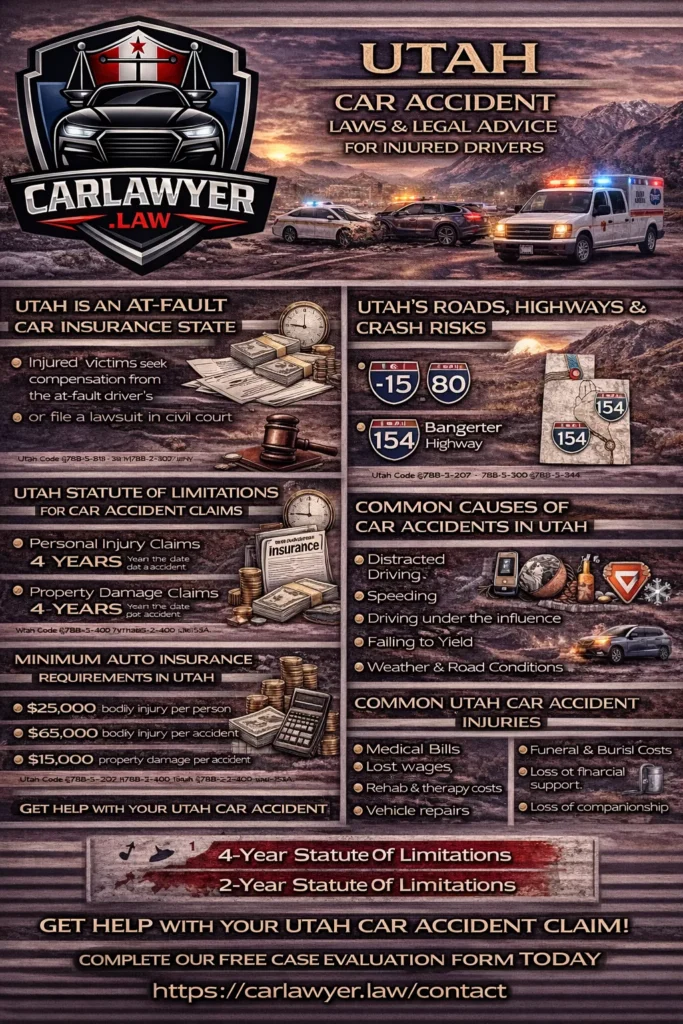
Infographic by CarLawyer.Law outlining Utah car accident laws and legal guidance, featuring the CarLawyer.Law logo, a crash scene backdrop, and sections on at-fault insurance rules, statute of limitations, major Utah highways, common causes of car accidents, typical injuries, minimum insurance requirements, and a call to action to complete a free case evaluation form.

Is Utah a Fault or No-Fault Car Insurance State?

Utah is an at-fault (tort) state for car accidents. This means the driver who caused the crash is financially responsible for injuries and damages suffered by other drivers, passengers, pedestrians, and property.

In practical terms, this means an injured driver in Utah generally:

  1. Files a claim with the at-fault driver’s insurance company, or
  2. Pursues a personal injury lawsuit in civil court if insurance is insufficient.

Utah does not use a no-fault system like Florida or New York, where victims must first turn to their own insurers regardless of fault. Instead, liability and fault are central to the legal process.


Utah’s Modified Comparative Fault Rule

Utah follows a modified comparative negligence rule under Utah Code §78B-5-818.

Under this rule:

  • You can recover compensation only if you are less at fault than the other party (i.e., less than 50% at fault).
  • Your total compensation is reduced by your percentage of fault.
  • If you are 50% or more at fault, you are barred from recovery.

For example:
If your total damages are $100,000 and you are found 25% at fault, you may recover $75,000 (your damages minus your fault percentage). However, if you are 50% or more at fault, you would not be eligible to recover any compensation.

Because liability plays such a crucial role in Utah car accident cases, gathering strong evidence early—such as witness statements, police reports, and accident reconstruction—is imperative.


Utah Statute of Limitations for Car Accident Claims

Utah imposes strict deadlines for filing car accident lawsuits. These deadlines are known as the statute of limitations, and if you miss them, your case will likely be dismissed.

Personal Injury Claims

You generally have 4 years from the date of the accident to file a personal injury lawsuit.
Reference: Utah Code §78B-2-307

Property Damage Claims

You also have 4 years from the date of the accident to file a lawsuit for property damage.

Wrongful Death Claims

In the tragic event of a fatal crash, you typically have 2 years to file a wrongful death lawsuit from the date of death.

Even though these deadlines may seem long, acting early ensures the preservation of evidence, medical records, and witness testimony, all of which diminish over time.


Minimum Auto Insurance Requirements in Utah

Utah drivers must carry minimum liability insurance. The required limits can be summarized as follows:

  • $25,000 for bodily injury liability per person
  • $65,000 for bodily injury liability per accident
  • $15,000 for property damage liability per accident

These minimums are often written as 25/65/15 on insurance documentation.

Many victims find these amounts inadequate after serious accidents. Purchasing higher limits and adding uninsured/underinsured motorist coverage (UM/UIM) can provide crucial protection if the other driver has no insurance or insufficient coverage.


Utah’s Roads, Highways & Crash Risks

Utah’s geography and traffic patterns contribute to certain high-risk areas for collisions:

Interstate 15 (I-15)

Running north–south through major cities such as Salt Lake City, Ogden, and Provo, I-15 carries heavy commuter and commercial traffic, especially during peak travel hours.

Interstate 80 (I-80)

An east–west corridor used by long-haul truckers and cross-country travelers, I-80 sees high speeds and frequent weather-related hazards in winter.

State Route 154 (Bangerter Highway)

A busy commuter route with multiple intersections and high-volume traffic.

Utah Highway 89

A scenic route with a mix of rural and suburban driving conditions.

Urban Areas

Salt Lake City, Provo, Ogden, and St. George each have dense traffic, congestion, and complex intersections that contribute to a high volume of accidents.


Common Causes of Car Accidents in Utah

Accidents can happen for many reasons, but some of the most common causes in Utah include:

Distracted Driving

Texting, phone use, and in-car technology distractions remain among the top contributors to crashes.

Speeding

High speeds reduce reaction time and increase injury severity in crashes.

Driving Under the Influence

Alcohol and drug impairment, including prescription impairment, remain significant causes of serious and fatal accidents.

Failing to Yield

Collisions often occur at intersections when drivers fail to yield the right of way.

Weather and Road Conditions

Rain, snow, ice, and fog are common during Utah’s winter and transitional seasons, leading to hazardous driving conditions.

Tailgating and Aggressive Driving

Close following distances and aggressive behaviors contribute to rear-end crashes and multi-vehicle pileups.


Common Injuries in Utah Car Accidents

Car accident injuries can range from minor to catastrophic. Some typical injuries seen in Utah car accident cases are:

Symptoms of serious injuries may not appear immediately after a crash, making prompt medical care essential.


Types of Compensation in Utah Car Accident Cases

If another driver’s negligence caused your accident, you may be entitled to various forms of compensation, which generally fall into two categories:

Economic Damages

These are tangible financial losses with receipts and bills, such as:

Non-Economic Damages

These are subjective and not easily measured by bills, including:

  • Pain and suffering
  • Emotional distress
  • Loss of enjoyment of life
  • Disfigurement or permanent disability
  • Loss of companionship (in wrongful death cases)

Utah law allows a jury to consider both economic and non-economic damages when allocating compensation.


Dealing With Insurance Companies After a Car Accident

Insurance adjusters often move quickly after a crash and may ask injured drivers to provide recorded statements or sign documents. Common insurance tactics include:

  • Offering quick, lowball settlements
  • Misrepresenting policy coverage
  • Disputing the severity or cause of injuries
  • Attempting to shift liability to the injured party

Before accepting any settlement offer, it is crucial to understand the full value of your claim and consult with a qualified attorney.


Why Hiring a Utah Car Accident Lawyer Matters

Car accident claims often involve complex legal and factual issues, such as:

  • Determining fault and comparative negligence
  • Evaluating future medical care needs
  • Estimating long-term wage loss
  • Handling disputes with insurance companies
  • Filing lawsuits before deadlines lapse

An experienced Utah car accident lawyer can investigate your accident, gather evidence, work with medical and accident reconstruction experts, negotiate with insurers, and advocate for your best interests throughout the claims process.


What to Do After a Utah Car Accident

Taking the right steps immediately after a crash can strengthen your claim:

  1. Call 911 and request medical assistance
  2. Document the scene with photos and videos
  3. Exchange information with other drivers
  4. Collect witness contact details
  5. Seek medical attention promptly
  6. Preserve evidence (police reports, medical records, receipts)
  7. Avoid recorded statements or signing releases without legal counsel
  8. Consult a Utah car accident lawyer before settling

Get Help With Your Utah Car Accident Claim

If you were injured in a car accident in Utah, you don’t have to navigate the legal process alone. Understanding your rights and obligations under Utah law can make a significant difference in your recovery.

Complete our free case evaluation form to speak with a qualified Utah car accident attorney and learn how we can help you pursue full compensation.


Sources

  1. Utah Code §78B-2-307 – Statute of Limitations
    https://le.utah.gov/xcode/Title78B/Chapter2/78B-2-S307.html
  2. Utah Department of Public Safety – Crash Facts & Statistics
    https://publicsafety.utah.gov/utmvc/crash-statistics/
  3. Utah Insurance Department – Auto Insurance Requirements
    https://insurance.utah.gov/consumer/auto-insurance