Car accidents happen every day across Texas’s vast highway system, busy metro areas, and rural roads. From congested interstates in Houston and Dallas to long stretches of highway connecting West Texas communities, drivers face unique risks statewide. If you were injured in a crash, understanding Texas car accident laws, fault rules, deadlines, and compensation options is critical to protecting your rights and maximizing your recovery – that’s why you need a Texas car accident lawyer.
Below is a comprehensive, Texas-specific guide to car accident claims—focused exclusively on passenger vehicle accidents, not truck crashes.

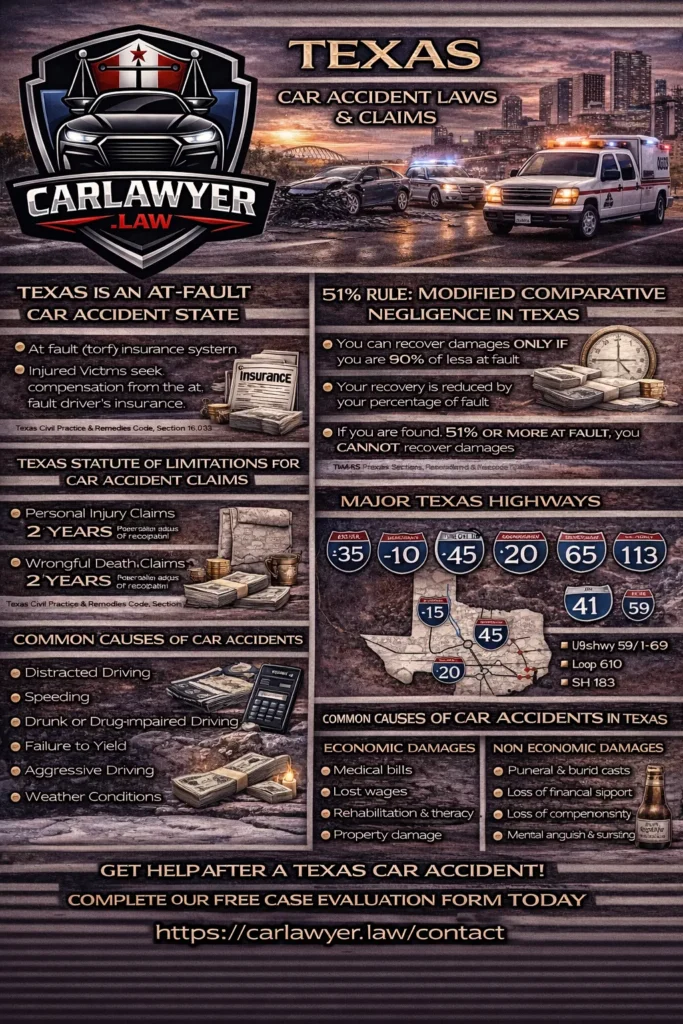
Texas follows an at-fault (tort-based) system for car accidents. This means the driver who caused the crash is financially responsible for the resulting damages.
After a Texas car accident, an injured person may pursue compensation by:
Unlike no-fault states, Texas does not require injured drivers to go through their own insurance for medical bills regardless of fault.
Texas uses a modified comparative negligence system under the 51% bar rule.
Example:
If you are awarded $100,000 but found 20% at fault, your recovery is reduced to $80,000.
Insurance companies frequently attempt to shift blame to reduce payouts, making fault analysis a critical part of Texas car accident claims.

Texas law imposes strict deadlines for filing car accident lawsuits:
Failing to file within the statute of limitations typically results in losing your right to seek compensation entirely. Certain limited exceptions may apply, but they are rare and should never be relied upon.
All Texas drivers are required to carry minimum liability insurance, commonly written as 30/60/25:
These minimums are often insufficient in serious injury cases. Many victims rely on:
If the at-fault driver lacks insurance or carries only minimum limits, additional coverage can make a substantial difference.
Texas has more miles of roadway than any other state, and several corridors see consistently high crash volumes:
Urban congestion, long-distance travel, high speed limits, and distracted driving contribute to elevated crash risks statewide.

Texas car accidents are often caused by preventable driver behavior, including:
Texting, GPS use, eating, and in-car technology are leading contributors to crashes, particularly in metropolitan areas.
Texas has some of the highest posted speed limits in the country. Speeding reduces reaction time and increases injury severity.
Despite strict laws, impaired driving remains a significant problem across Texas highways and city streets.
Intersection crashes are common when drivers ignore traffic signals, stop signs, or fail to yield while turning.
Tailgating, unsafe lane changes, and road rage frequently result in rear-end and sideswipe collisions.
Heavy rain, flooding, fog, and dust storms—especially in Central and West Texas—can dramatically increase crash risks.
Car accidents can result in a wide range of injuries, from mild to catastrophic:
Even injuries that appear minor initially can worsen over time, making prompt medical evaluation essential.
Depending on the facts of the case, injured victims may recover compensation for:
When a fatal car accident occurs, surviving family members may seek compensation for:
Texas does not cap damages in standard car accident injury cases.
Insurance adjusters often move quickly after a crash and may:
Early settlement offers frequently undervalue long-term medical costs and future damages. Accepting an offer too soon may permanently waive your right to additional compensation.

You should strongly consider legal guidance if:
An experienced car accident attorney can investigate the crash, preserve evidence, negotiate with insurers, and pursue full compensation under Texas law.
If you or a loved one was injured in a Texas car accident, you do not have to navigate the legal process alone. Understanding your rights, deadlines, and options is the first step toward recovery.
Take the next step today by completing our
👉 free case evaluation form
Your consultation is confidential, and there is no obligation to move forward.