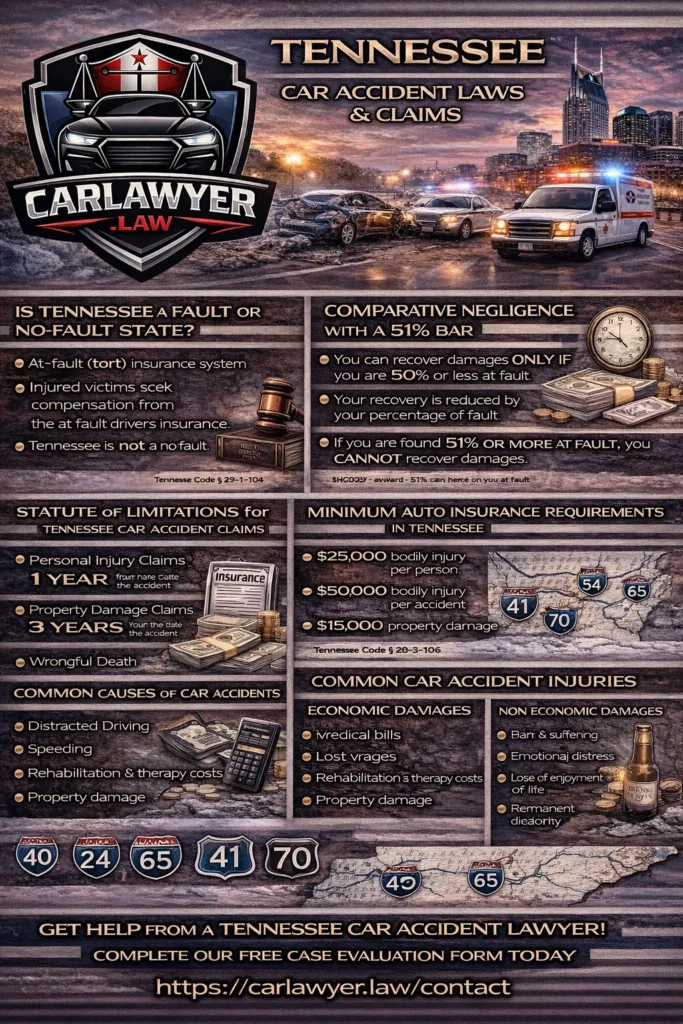
Car accidents in Tennessee can be devastating, causing serious injuries, significant medical expenses, lost income, and emotional distress for victims and their families. Whether a collision occurs on a rural backroad, a busy Nashville highway, or a city street in Memphis or Knoxville, understanding Tennessee’s specific laws and legal deadlines is crucial to protecting your rights and securing fair compensation – that’s why you need a Tennessee car accident lawyer.
This comprehensive guide explains Tennessee car accident laws, how fault is determined, insurance requirements, the statute of limitations, common causes of accidents, typical injuries, and the types of compensation available after a car crash.

Tennessee is a fault (tort) state for car accidents. This means that after an accident, the driver who caused the crash is responsible for the resulting damages. Injured victims can pursue compensation from the at-fault driver’s insurance company, and if necessary, file a personal injury lawsuit to recover damages.
Unlike no-fault states, Tennessee does not require drivers to first file claims with their own insurance regardless of fault. Instead, liability is determined based on negligence.
Tennessee follows a modified comparative fault rule with a 51% bar under Tennessee Code § 29-11-104. Under this system:
For example, if a jury awards $100,000 in damages but finds you 30% at fault, your recovery would be reduced to $70,000. If you are found to be 51% at fault, you cannot recover compensation.
This rule makes establishing fault and liability a central issue in Tennessee car accident claims.

Like all states, Tennessee has a strict deadline for filing car accident lawsuits. These deadlines are critical because failing to file within the required time can permanently bar your right to compensation.
Because Tennessee’s personal injury deadline is relatively short, acting quickly after an accident is essential to preserve your legal rights.
Tennessee drivers are required to carry minimum liability insurance, including:
These minimums satisfy the state’s legal requirements but are often insufficient to cover medical expenses and other losses from serious crashes.
Tennessee does not require drivers to carry uninsured/underinsured motorist (UM/UIM) coverage, but insurance companies must offer it. Having UM/UIM coverage can be critical when the at-fault driver has inadequate insurance or no insurance at all.
Accidents occur throughout Tennessee, but certain roadways and areas see particularly high traffic volumes and risks:
Construction zones, rush-hour congestion, and high-speed rural travel contribute to collision risks.

Many Tennessee car accidents result from preventable driver behaviors and hazardous conditions, including:
Texting, cellphone use, navigation systems, and other distractions are leading causes of crashes statewide.
Traveling above posted speed limits reduces reaction time and increases injury severity.
Alcohol and drug impairment contribute significantly to fatal and serious injury collisions in Tennessee.
Intersection crashes occur frequently when drivers fail to obey traffic signals or yield the right of way.
Tailgating, unsafe passing, and erratic lane changes increase crash risks on highways and city streets.
Rain, fog, and occasional ice can make roads slick and reduce visibility.
Car accidents can cause a broad range of injuries, from minor to life-altering, including:
Prompt medical care is essential, even for injuries that may not immediately present symptoms.
Injured victims may be entitled to compensation for both economic and non-economic damages, including:
If a loved one dies in a Tennessee car accident, surviving family members may pursue compensation for:
The total value of a claim depends on factors such as the severity of injuries, long-term care needs, and the impact on the victim’s life.
Insurance companies may attempt to limit their financial exposure by:
An experienced attorney can counter these tactics and ensure your claim is evaluated fairly.

Taking the right steps after a crash improves your health and legal position:
If you were injured in a Tennessee car accident, you do not have to navigate the legal system alone. An experienced car accident attorney can investigate your case, gather evidence, communicate with insurance companies, and pursue the full compensation you deserve.
Complete our free case evaluation form to discuss your legal options with a Tennessee car accident lawyer today.