Car accidents happen every day on Nevada’s busy highways, city streets, and tourist corridors. From high-speed crashes on I-15 to intersection collisions along the Las Vegas Strip, Nevada drivers face unique risks—and specific legal rules—after a motor vehicle accident. You need a Nevada truck accident lawyer to help you get the compensation that you deserve.
This state-specific guide explains Nevada car accident laws, statutes of limitations, common causes and injuries, available compensation, and what victims should know to protect their rights.

Nevada follows a fault-based (at-fault) system for car accidents. This means the driver who caused the crash is financially responsible for the resulting damages.
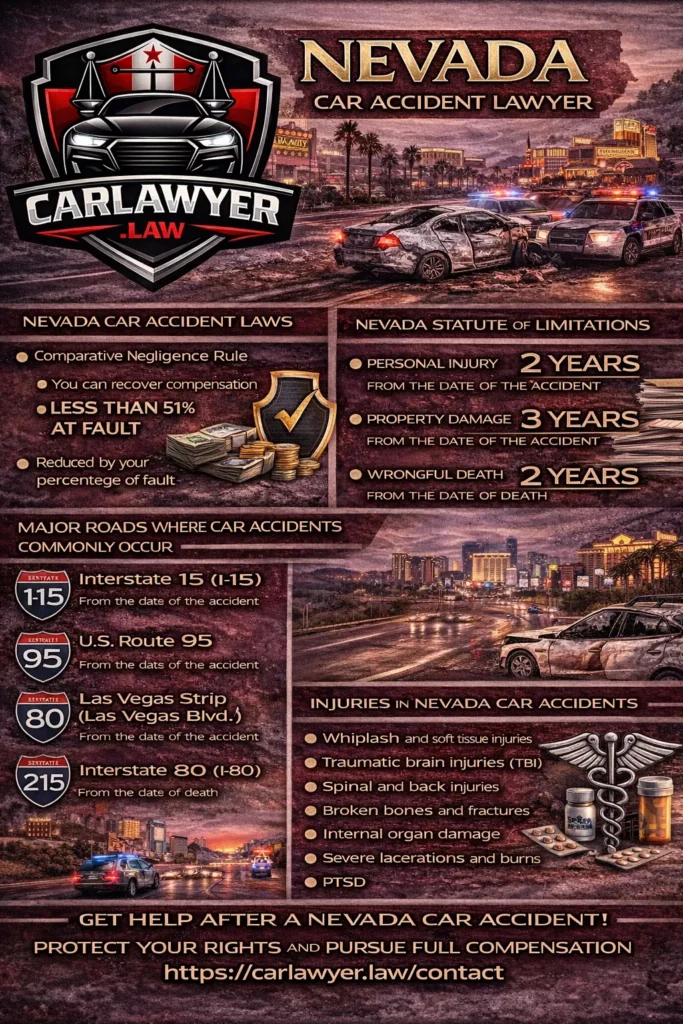
Nevada uses a modified comparative negligence rule under NRS §41.141. You may recover compensation only if you are less than 51% at fault for the accident. However, your total compensation will be reduced by your percentage of fault.
Example:
If you are awarded $100,000 but found 20% at fault, your recovery is reduced to $80,000.
If you are 51% or more at fault, you cannot recover damages.
All Nevada drivers must carry minimum liability insurance, including:
Nevada also requires uninsured/underinsured motorist (UM/UIM) coverage to be offered, though drivers may reject it in writing. UM/UIM coverage is especially important in Nevada, where many accidents involve uninsured or minimally insured drivers.

Timing is critical after a car accident. Nevada law strictly limits how long victims have to pursue a claim.
Failing to file within these deadlines may permanently bar your claim, regardless of how strong your case is.
Nevada’s unique geography and tourism-driven traffic create dangerous driving conditions on several major roadways:
Tourists unfamiliar with local roads, aggressive driving, and excessive speeds contribute to high accident rates statewide.

Car accidents in Nevada often result from preventable driver behaviors, including:
Texting, GPS use, and in-vehicle entertainment systems are leading contributors to crashes—especially in urban areas like Las Vegas and Reno.
Nevada’s wide-open highways encourage excessive speed, increasing both crash frequency and injury severity.
Despite strict DUI laws, impaired driving remains a significant cause of serious and fatal accidents across the state.
Intersection crashes often occur when drivers ignore traffic signals or fail to yield the right of way.
Long desert stretches and late-night travel contribute to driver fatigue, slowing reaction times and increasing crash risk.
Car accidents can cause injuries ranging from minor to catastrophic, including:
Even low-speed collisions can cause lasting injuries that require extensive medical treatment and rehabilitation.
If another driver caused your accident, you may be entitled to recover compensation for both economic and non-economic damages.
In rare cases involving egregious misconduct—such as drunk driving—Nevada courts may award punitive damages to punish the at-fault driver.
Taking the right steps after a crash can protect both your health and your legal claim:
Insurance companies often try to minimize payouts—especially when comparative fault is involved.

Nevada car accident cases often involve:
Having a clear understanding of Nevada law is critical to protecting your claim. You need to hire a Nevada car accident lawyer.
If you or a loved one has been injured in a Nevada car accident, you do not have to navigate the legal process alone. Understanding your rights, deadlines, and compensation options can make a significant difference in your recovery.
Take the next step today by completing our free case evaluation form to discuss your Nevada car accident claim.