Connecticut Car Accident Lawyer

Car accidents in Connecticut frequently occur on congested interstates, urban roadways, and heavily traveled commuter corridors connecting New York and New England. From high-speed crashes on I-95 to multi-vehicle accidents during winter storms, Connecticut car accidents often lead to serious injuries and complex insurance disputes. If you were injured in a crash, understanding Connecticut car accident laws, filing deadlines, and how fault is determined is essential to protecting your right to compensation.

Car accidents in Connecticut frequently occur on congested interstates, urban roadways, and heavily traveled commuter corridors connecting New York and New England. From high-speed crashes on I-95 to multi-vehicle accidents during winter storms, Connecticut car accidents often lead to serious injuries and complex insurance disputes. If you were injured in a crash, understanding Connecticut car accident laws, filing deadlines, and how fault is determined is essential to protecting your right to compensation – that’s why you need a Connecticut car accident lawyer.

At CarLawyer.Law, we focus exclusively on helping car accident victims navigate state-specific laws and pursue the full compensation they deserve.


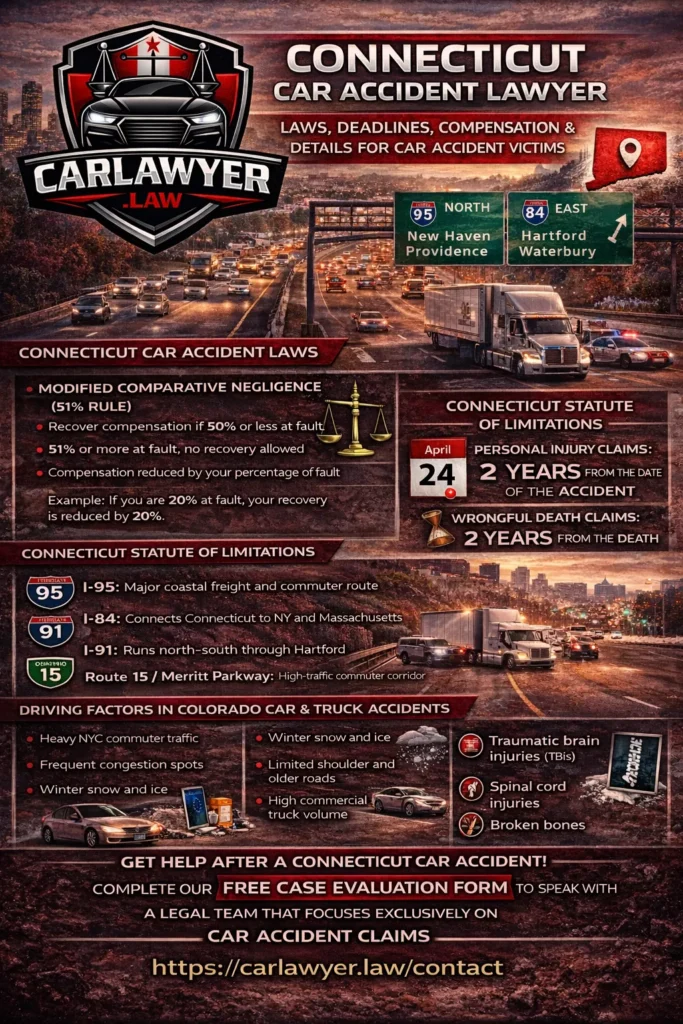
Infographic for CarLawyer.Law titled “Connecticut Car Accident Lawyer” featuring the CarLawyer.Law logo and a congested Connecticut highway background. The infographic explains Connecticut car accident laws, including the modified comparative negligence 51% rule and the at-fault insurance system, the two-year statute of limitations for personal injury and wrongful death claims, major trucking and commuter corridors such as I-95, I-84, I-91, and Route 15 (Merritt Parkway), common causes of car and truck accidents including heavy commuter traffic and winter weather, serious injuries sustained in crashes, compensation available to victims, and a call to action to complete a free case evaluation form at CarLawyer.Law.

Connecticut Car Accident Laws

Connecticut follows a fault-based system with a modified comparative negligence rule.

Modified Comparative Negligence (51% Rule)

Connecticut uses a modified comparative negligence system, which means:

  • You can recover compensation if you are 50% or less at fault
  • If you are 51% or more at fault, you are barred from recovery
  • Your compensation is reduced by your percentage of fault

Example: If you are found 20% at fault, your compensation is reduced by 20%.

Because fault allocation directly affects compensation, insurance companies in Connecticut often aggressively dispute liability.

At-Fault Insurance System

Connecticut is an at-fault state, meaning:

  • The driver who caused the accident is financially responsible
  • Claims are filed against the at-fault driver’s insurance company
  • Lawsuits may be necessary if insurers deny or undervalue claims

Connecticut Statute of Limitations for Car Accidents

Connecticut law imposes strict deadlines for filing accident claims:

  • Personal injury claims: 2 years from the date of the accident
  • Wrongful death claims: 2 years from the date of death

If a claim is not filed within these time limits, the injured party may permanently lose the right to compensation.


Major Trucking Corridors & Highways in Connecticut

Despite its small size, Connecticut is a major transportation corridor for commercial trucking throughout the Northeast.

Key highways include:

  • Interstate 95 (I-95): Major coastal freight and commuter route
  • Interstate 84 (I-84): Connects Connecticut to New York and Massachusetts
  • Interstate 91 (I-91): Runs north–south through Hartford
  • Route 15 / Merritt Parkway: High-traffic commuter corridor

Car accidents involving large commercial trucks on these highways often result in severe injuries due to congestion, speed, and limited reaction time.


What’s Unique About Car & Truck Accidents in Connecticut

  • Heavy commuter traffic from New York City
  • Frequent congestion on short highway segments
  • Winter weather including snow and ice
  • Older roadways with limited shoulder space
  • High volume of commercial trucking despite short distances

These factors often contribute to rear-end collisions, multi-vehicle crashes, and serious injury claims.


Common Causes of Car Accidents in Connecticut

Connecticut car accidents are commonly caused by:

Traffic congestion significantly increases the likelihood of chain-reaction crashes.


Common Car Accident Injuries

Due to traffic density and frequent highway crashes, Connecticut car accidents often result in:

Many injuries require ongoing medical treatment and long-term care.


Compensation Available to Connecticut Car Accident Victims

Depending on the circumstances, injured victims may be entitled to compensation for:

Economic Damages

Non-Economic Damages

  • Pain and suffering
  • Emotional distress
  • Loss of enjoyment of life
  • Permanent disability or disfigurement

Wrongful Death Damages

  • Funeral and burial expenses
  • Loss of financial support
  • Loss of companionship and care

Connecticut does not impose strict caps on most car accident damages, making full claim evaluation critical.


Why Connecticut Car Accident Claims Can Be Challenging

Insurance companies often attempt to:

  • Shift blame to reduce payouts
  • Minimize injury severity
  • Dispute medical treatment necessity
  • Pressure victims into early settlements

Cases involving commercial trucks may also involve multiple insurers and corporate defenses.


Why Legal Guidance Matters After a Connecticut Car Accident

Without legal representation, accident victims risk:

  • Accepting settlements that fail to cover future costs
  • Being unfairly assigned fault
  • Missing filing deadlines
  • Underestimating long-term medical needs

A lawyer experienced with Connecticut car accident laws can protect your rights and pursue maximum compensation.


Get Help After a Connecticut Car Accident

If you or a loved one has been injured in a Connecticut car accident, do not delay taking action. Evidence can disappear quickly, and insurance companies act fast to protect their interests.

Complete our free case evaluation form today to speak with a legal team that focuses exclusively on car accident cases.


Authoritative Sources & References

  1. Connecticut General Statutes – Personal Injury Law
    https://law.justia.com/codes/connecticut/
  2. Connecticut Department of Transportation (CTDOT)
    https://portal.ct.gov/DOT
  3. National Highway Traffic Safety Administration – Connecticut Data
    https://www.nhtsa.gov/road-safety/connecticut